- Carry out all plastic, tin and other non-biodegradable material you carry in.
- Respect sacred sites and local traditions. Remove your shoes before entering temples.
- Ask for permission before taking people’s photographs. It is important to respect people’s privacy.
- Respect mealtimes and customs of your homestay family.
- GBPNIHE, Sikkim Regional Centre, Pangthang, Gangtok
- Photo Gallery
Dzongu
Home / Pilot
site / Dzongu
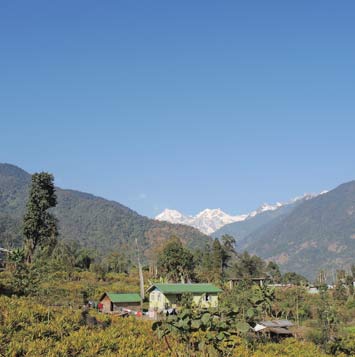
Location: Dzongu is in North Sikkim and is a Lepcha (indigenous) community reserve and
transition area
to the Khangchendzonga Biosphere Reserve, a UNESCO World Heritage Site. The Dzongu site is surrounded by
the Tholung chu (river) on the northeastern side and the guardian deity Mount Khangchendzonga on the
western side.
Climate: Dzongu has a diverse range of eco-climactic zones, ranging from 800m to 4595m
elevation.
Villages: The word Dzongu means “a place with nine districts” derived from Bhutia
Language.
Lingthem-Lingdem GPU in upper Dzongu is the pilot village in this region under the KLCDI-India
programme, with five wards inhabited by 186 households for a total population of 987.
Culture: The ancient tribe of Sikkim, the Lepchas, has been living in this area for
centuries. The
Lepcha community has a vibrant culture and vast traditional knowledge of the local biodiversity,
including knowledge of medicinal plants.
Biodiversity
Floral Diversity:The pilot site as a whole represents unique and rich assemblage of biological diversity. Major tree species are Abiesdensa, Acer spp., Betula utilis, Symplocos spp., Quercus spp., and Viburnum spp., etc, with pure or mixed stands of various Rhododendron species. Important shrub species include, Aconogonum spp., Berberis spp., Daphne cannabina, Rubus spp., and Urtica spp., and the dominant herbs are Iris decora, Rubia cordifolia, Eragrostis spp., Drymeria cordata, Hemiphragma heterophyllum, Viola bicolor, Anaphali contorta, Anaphalis margaritacea, Fragaria nubicola ,Cautley spicata, etc. Some of the important medicinal plants include Aconitum palmatum, Aconitum ferox, Artemisia vulgaris, Bergenia ciliata, Swertia chirayita, Zanthoxylum acanthopodium, Litsea citrata , Heracleum wallichii and Evodia fraxinifolia (Khanakpa). The region harbors varieties of Bamboo species some of which are Bambusa tulda, Sinarundinaria hookeriana, Yushania maling and Phyllostachys maniias common elements.
Faunal Diversity:The Red Panda (Ailurusfulgens), Clouded Leopard (Neofelis nebulosa), Himalayan palm civet (Paguma larvata), Musk Deer (Moschus chrysogaster), Yellow throated Marten (Martesf lavigula) and Goral (Nemorhaedus goral), Nepal House-Martin (Delichon nepalensis), Himalayan Black Bear (Selanarctosthibetanus), Jackal (Canis aureus), Himalayan Thar (Hemitragus jemlahicus), Barking Deer (Muntiacus muntjack) are the important animals of pilot site. Important avifaunal diversity includes the Blood Pheasant (Ithaginis cruentus), Himalayan Monal (Lophophorus impejanus), Darjeeling Pied Woodpecker (Dendrocopos darjellensis),etc.
Agrobiodiversity: Major crops like finger millet, potatoes, sweet potatoes, yam, maize, cabbage, spinach, beans, peas, broccoli, radish, carrots, lentils, pulses, and nakima, are cultivated here. Cash crops like ginger, large cardamom, orange, and guava, are also common. Livestock includes pigs, goats, cows, ducks, and hens.
Do's
Dont's
- Pollute streams, rivers, and other water sources with chemical detergents, soaps, or shampoos.
- Harm or remove local plants and animals. Leave the environment better than you found it.
- Leave cigarette butts or start open fires in the forest.
- Contribute to noise pollution. Avoid blasting music in reserve areas.
-
 Rhododendron Festival
Enjoy stunning views of mountainsides turned pink by hundreds of . . .
Rhododendron Festival
Enjoy stunning views of mountainsides turned pink by hundreds of . . .
-
 Cultural Festival
There is a Lingdem Hot Spring Nature and Culture Tourism Festival every year! Come to enjoy
sporting events,
Cultural Festival
There is a Lingdem Hot Spring Nature and Culture Tourism Festival every year! Come to enjoy
sporting events,
-
 Elephant migration
Discover the beauty of the majestic elephant . . .
Elephant migration
Discover the beauty of the majestic elephant . . .
-
 Trek
On some of the best routes in India and across the Himalayas
Trek
On some of the best routes in India and across the Himalayas
-
 Stay
In cozy homestays with home-cooked, organic meals
Stay
In cozy homestays with home-cooked, organic meals
-
 Explore
The incredibly diverse local flora, fauna, and culture
Explore
The incredibly diverse local flora, fauna, and culture
-
 Relax
In the fresh mountain air with beautiful panoramic views
Relax
In the fresh mountain air with beautiful panoramic views





Copyright All Right Reserved
Website is developed under KLCDI-India programme